Think about your favorite pair of jeans. The ones that just work. You throw them on without thinking, and somehow they fit whatever the day turns into.
Now think about what those jeans actually have to do. You sit on a plane in them for six hours. You walk twelve thousand steps. You spill coffee on them and barely notice. You get caught in a drizzle. You go from a meeting to a dinner to a flight home, and they hold up the whole way.
The traditional denim we are all used to couldn’t do all of that. The jeans your dad wore looked great and lasted forever, but they fought you a little. They were stiff in the morning. They got heavy in the rain. You changed out of them when you wanted to actually move.
The new generation of tech denim is different. It stretches when you stretch. It breathes when you sweat. Water rolls off it. Brands like DUER, BYLT, The North Face, and Northbound Gear are leading this shift, and the people buying their jeans aren’t treating them as something special. They’re just wearing them every day, the way you wear your favorites.
If you’re thinking to add denim to your collection, watch this article closely and download our Market Intel
From Workwear to Wardrobe Backbone
Denim was a work fabric for most of its life. Built for friction, indifferent to comfort, kept in the wardrobe because it lasted longer than anything else. Casualwear inherited it almost by accident. What it traded for that staying power was movement.
That trade has expired. The brands shaping today’s denim aren’t choosing between heritage and performance. They’re collapsing the two. DUER builds stretch into cotton without losing the cotton. BYLT engineers recovery into twill so the fabric remembers its shape. The North Face puts a water-resistant shell behind a denim face. Northbound Gear lines its jeans with microfleece for cold mornings.
Each of them looks like denim from the front. Each of them does something denim has never done before.
A Longer Fabric Brief Behind a Familiar Look
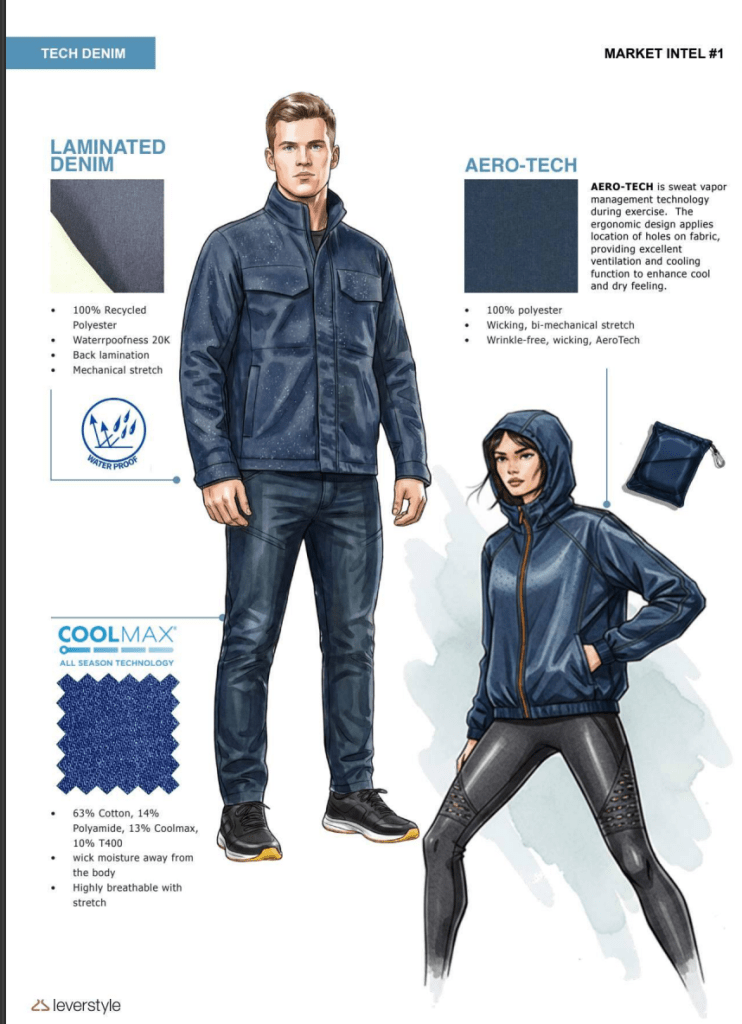
The visual is denim. The brief is not. A modern tech denim fabric specification quietly carries four-way stretch, moisture wicking, water repellency, breathability, and recycled or natural fibre content inside a single construction. The fabric arrives looking ordinary and behaves like something else entirely.
A few constructions in current production tell the story:
• Laminated denim: 100% recycled polyester face, mechanical stretch, back lamination, 20K waterproof rating. Looks like denim. Performs like a hardshell.
• Aero-tech denim: 100% polyester base, bi-mechanical stretch, sweat vapor management built into the structure, wrinkle resistance through finish.
• Coolmax blend: 63% cotton, 14% polyamide, 13% Coolmax, 10% T400. Wicking with a real cotton hand and visible cotton character.
None of these come off a shelf. They’re built. Each one demands a specific yarn programme, controlled finishing, and technical development time that traditional denim mills can’t run alongside their regular indigo. A factory built for raw and selvedge isn’t going to switch into laminated polyester production without breaking everything else on its calendar.
The aesthetic is familiar. The supply chain underneath looks more like activewear
Where Performance Meets Natural Fibre
The harder version of the brief is the one that keeps cotton in. Synthetic-only performance fabrics have been figured out. Recycled polyester takes DWR cleanly, accepts lamination, and holds shape after the third wash. The chemistry is sorted.
Cotton-heavy denim is a different animal. Cotton and spandex don’t always cooperate, and that argument shows up as distortion in the finished fabric. Finish chemistry behaves one way over indigo and another way over solid-dyed knits. Shrinkage has to be controlled across two fibres reacting to heat at different rates. And hand feel after the third or fourth wash is where most early prototypes quietly lose their case.
The constructions that hold up share a structure: cotton-dominant base, technical fibre under 20%, finish stack tuned to the yarn ratio rather than applied as a default. A few that work in current production:
• 62% cotton, 34% polyamide, 4% elastane at 200gsm: stretch and breathability without losing the cotton hand
• 71% polyester, 18% rayon, 11% spandex at 161gsm: quick-dry with twill drape
• 52% modal, 48% Sorona at 200gsm: a full sustainable claim with stretch built into the bio-based fibre
Sourcing The Next Wave of Tech Denim
Tech denim isn’t replacing denim. It’s expanding what denim is allowed to do. The brands building this category well aren’t switching suppliers. They’re working with manufacturing structures that can hold heritage and performance inside one program. The brief gets longer. The execution stays consolidated. And the customer, the one pulling on a pair of jeans for a flight or a hike or an afternoon that drifts somewhere unexpected, never has to think about any of it.
Contact us to develop your next tech denim program with Lever Style.