Most Shopify owners think finding a clothing manufacturer is the hard part. It is not. Getting a good one to take you seriously is the hard part, and that comes down to what you bring to the first conversation.
If you have been running on print-on-demand, this is things start changing. Print-on-demand removes every operational decision. Real production puts those decisions back in your hands, and a factory expects you to have answered most of them before you reach out. Brands that skip the prep work might get ignored or quoted at bad terms, and it will take many months before your production can even get started.
This article covers what to define before you start searching, the metrics that determine who can actually work with you, and how to evaluate a factory once they respond.
What to define before you contact anyone
A factory’s first email back is usually a series of questions. The faster you can answer them, the faster you move from another small brand inquiry to a real prospect.
Start with what you are making. Not tee shirts, but the specific construction, weight, and finish — fabric weight in GSM, knit or woven, the silhouette and fit you are targeting, and the finishing details that distinguish the garment.
Then settle the timeline. Which season are you producing for, and when do you need stock to hit it? For many factories, standard production runs 60 to 90 days after sample approval, plus 30 to 60 days for fabric, plus shipping. Brands that compress this end up paying air freight premiums or missing their launch.
Country of origin is also an important decision to make.Different regions have different strengths. Some have deeper fabric mills and faster sampling, others offer better duty treatment or shorter shipping lanes to your market. Tariff exposure varies by trade agreement and current policy and is worth checking before you commit. Pick the country your specific product needs, not the one that sounds best in general.
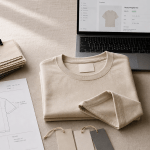
Finally, a basic tech pack. For a first run this can be lightweight: a clean sketch, measurement points, fabric specification, trim list, and care label requirements. You do not need a fully graded spec at the inquiry stage, but you need enough that a factory can quote without guessing.
The numbers that decide who will work with you
Three numbers separate factories you can use from ones you cannot.
The first is minimum order quantity. Many premium factories sit at 500 to 1,000 units per style per color. A low MOQ clothing manufacturer might go down to 100 or 200 per style, with a higher unit price in exchange. If you launch with three styles in three colors each, a 500-piece MOQ means 4,500 units committed before you have any sales data. Match the MOQ to your cash flow, not to ambition.
If you are just starting out, the most important thing is to work with a partner that understands low MOQ production and is set up to support you at that scale. A factory built around 2,000-piece runs will quote you, but the relationship will be friction the whole way through.
The main driver of MOQ is fabric. Mills have their own minimums, often 300 to 500 meters per color, and a factory cannot order less just because you want to. The lever you have is fabric sourcing. Using a stock fabric the factory already has on hand, paired with stock trims, can drop your MOQ to 100 or 200 units without a unit-price penalty. A common path for new brands is to design the first drop around stock fabric, prove the product, then switch to a nominated fabric once volume justifies the mill minimum. Factor this into your design choices before you finalize the tech pack — picking an exotic fabric weight or a custom dye color on a first run is what pushes MOQs from 200 to 1,000.
How to evaluate a clothing manufacturer once they respond
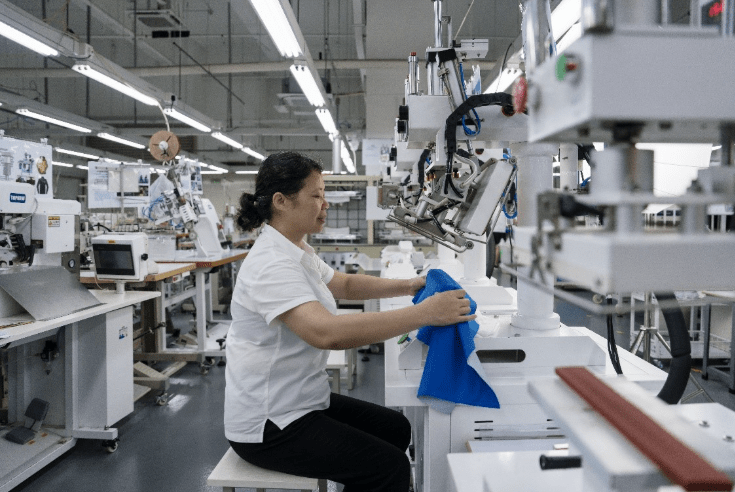
Start with credentials. Who do they already produce for? A factory’s existing client list is the clearest signal of the quality bar they operate at — if they make for brands you respect, they can make for you. Ask whether they handle multiple product categories under one roof: wovens, knits, outerwear, and cut-and-sew jersey each require different machinery and expertise, and a partner who covers more of your range as you grow saves you from building a second supply chain in eighteen months. Certifications matter too. B Corp status, WRAP, BSCI, GOTS, or Higg participation tell you the factory has been audited by someone other than themselves — useful both for your own diligence and for the sustainability claims you will eventually want to make to customers.
Always pay for a pre-production sample before placing a bulk order. Sample fees vary by style and category — a simple jersey tee sits at one end, a structured outerwear piece at the other — and are sometimes credited back against production. The sample is your only real data point on what the factory can produce. Check it against your tech pack for stitching density, fabric hand, label placement, and finishing.
Evaluate whether you need third-party inspection, or whether you are working with a partner that already has quality control built in. Independent inspectors visit the factory before shipment and check a percentage of the order against your specs, which is standard practice for any private label clothing manufacturer relationship and protects you from the worst outcome — paying in full for stock you cannot sell. Some manufacturers run their own in-house QC to the same standard and can share inspection reports directly, which removes the need to coordinate an outside firm. Either path works; what matters is that someone other than the production line is signing off before the goods leave the floor.
Read the purchase contract before you sign. Make sure the terms cover what happens if quality, timing, or quantity miss the mark, and that responsibilities on both sides are clearly spelled out. A factory that resists clear terms is telling you how the relationship will go.
Where this leaves you
Finding a manufacturer is not a research problem. It is a preparation problem. The brands that move smoothly from print-on-demand into real production already know what they want, what they can spend, and how they will judge what comes back, before the first email goes out.
Ready to move from print-on-demand to real production? Lever Studio is part of the Lever Style group, the publicly-listed manufacturing platform behind some of the most respected names in fashion. We help up-and-coming brands launch their first production run and scale into a full supply chain — with low-MOQ flexibility, multi-category capability under one roof, and the quality standards our parent group has built over 70 years producing for premium global labels. If you are ready to start your production, book a call with the Lever Studio team.