FW27 is already taking shape, and it is doing it in the hand of the cloth. This is a season decided by surface — what a fabric feels like under the fingers, how it catches light, what a print does when it is blurred instead of sharpened.
Which makes it a difficult season to read from a runway image alone. The silhouettes are familiar. The story is in the texture, the finish and the depth of the colour, and it only reveals itself up close.
So our product and material design team mapped the season the way it reads on the body: four directions — two fabric, two print — one set each for menswear and womenswear. What follows is the honest read: where they overlap, what pulls them apart, and what each one says about how FW27 wants to be worn. Note that FW27 and AW27 refer to the same season; both terms appear across the industry and we use them interchangeably.
Three Shifts Running Across the Whole Season
Surface is doing the work that graphics used to do. This continues a shift we flagged for SS27 menswear and it has now moved into both genders and into print. Devore grounds, cut-velvet pile, laser-cut suede, water-soluble embroidery that stands off the cloth, sequin-on-mesh. The pattern is legible before it is visible, which is a different production brief entirely.
The palette goes dark and earthy. Espresso suede, chestnut corduroy, bitter chocolate wool and charcoal anchor menswear. Near-black grounds, deep charcoal, warm ecru and taupe anchor womenswear. Very little of FW27 is bright, and where colour does appear it arrives through retro striping rather than through ground colour.
Animal print resets in both directions. Womenswear moves off realistic leopard toward polka dots, deer motifs and Dalmatian spots. Menswear keeps animal but recolours it and positions it as an alternative to camouflage. Brands carrying leopard into FW27 unchanged are working against the direction of the category.
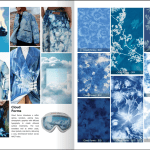
One theme, Cloud Forms, appears in both print books unchanged. Hazy atmospheric graphics and diffused typography, translating onto winter coats, down jackets and denim. It is the only genuinely cross-gender direction in the season.
FW27 Menswear Trends
Heritage, reworked rather than revived
Three of the eight menswear fabric directions sit here, and together they carry the largest share of the season.
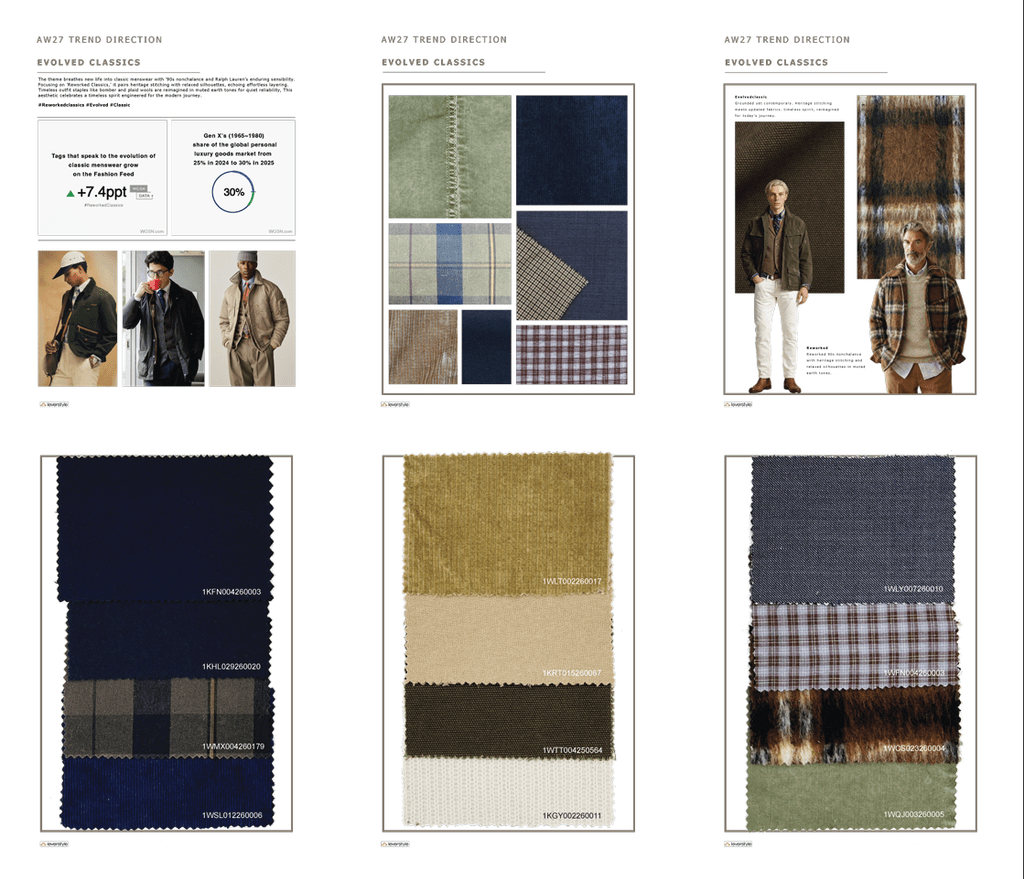
Neo Heritage reads brown and refined. Espresso suede, chestnut corduroy, bitter chocolate wool, jackets in herringbone and brushed flannel cut with structured shoulders and precise drape. Evolved Classics runs alongside it with 90s nonchalance and reworked staples, bomber shapes and plaid wools in muted earth tones. Western Heritage brings ranch tradition into it through bold geometric motifs, jacquard and fleece, and artisan leather.
The data supports the weight given to this group. Tags around the evolution of classic menswear rose 7.4 percentage points on the WGSN Fashion Feed, tailoring-adjacent tags rose 5.6 points, and #Oldmoney rose 1.2 points year on year. The Tribal keyword spiked 200 percent on Google Trends between April 2025 and 2026. Gen X now holds 30 percent of the global personal luxury goods market, up from 25 percent, which is the demographic reading underneath all three directions.
The print book extends the same territory. Western Heritage reframes Southwestern blanket motifs in weathered tones, Nostalgic Opulence softens baroque scrolls and worn floral jacquards into muted earth graphics, and Country Tales works pastoral toile and folk tilework.
Raw, washed and lived-in
Earth & Loom and Rugged Vintage are the tactile end of the season. Earth & Loom is built on heavy texture, hairy yarns and deep irregular piles, with earthy tones and natural materials carrying the eco-friendly read. US hemp production reached $445 million in 2024, up 40 percent, a sign that the appetite for raw, natural-feeling material is real rather than aspirational. Searches for soft utility grew 31 percent year on year.
Rugged Vintage is the resale market showing up in primary product. Distorted dyes, distressed textures, washed fabric, corduroy variety and vintage knit. Depop recorded roughly $1 billion in gross merchandise sales in 2025 with close to 60 percent year-on-year growth in the US, and #DistressedTexture rose 6.8 percentage points on the Fashion Feed.
The character of this direction is earned rather than woven in. Washing, fading and abrasion do the storytelling, giving a piece a past it never actually had. The prints work the same way: Charcoal Prints and Abstract Imperfections live in gradation and blur rather than crisp line.
Technical utility
Urban Pace redefines the commute through anti-wrinkle fabrics, performance-driven weaves and reinforced seams, with muted grey and deep navy dominant. Searches for comfort within apparel grew 31 percent year on year, and #CommuterStyle is up 40 percent since late 2025, with Instagram operating as a primary search engine for workwear essentials.
Fisherman Aesthetic pushes the same functional brief somewhere warmer and more social. Quick-drying, water-repellent performance fabrics against robust classic detailing, with stripes reimagined through technical construction. Engagement is up 45 percent year on year, driven by Gen Z experimentation and Gen X nostalgia, and rugby shirts currently carry the highest out-of-stock rate among cut-and-sew tops in the US at 23.8 percent.
Both directions ask performance to behave like fashion. Water repellency and quick-dry sit inside a wardrobe that still reads relaxed rather than sporty, which is what separates FW27 utility from technical outerwear.
Rock Romance
The outlier, and the one that will fit fewest brands. Gothic rebellion against poetic softness: leather and heavy corduroy paired with sheer satins and dark florals, tailored masculine silhouettes opened up with sheer layers and embroidery. #SkinnyJeans rose 0.7 percentage points on the AW26/27 catwalks, and Pinterest searches for mens alternative fashion grew 185 percent, grunge guy 115 percent.
FW27 Womenswear Trends
Quiet, fluid and elevated
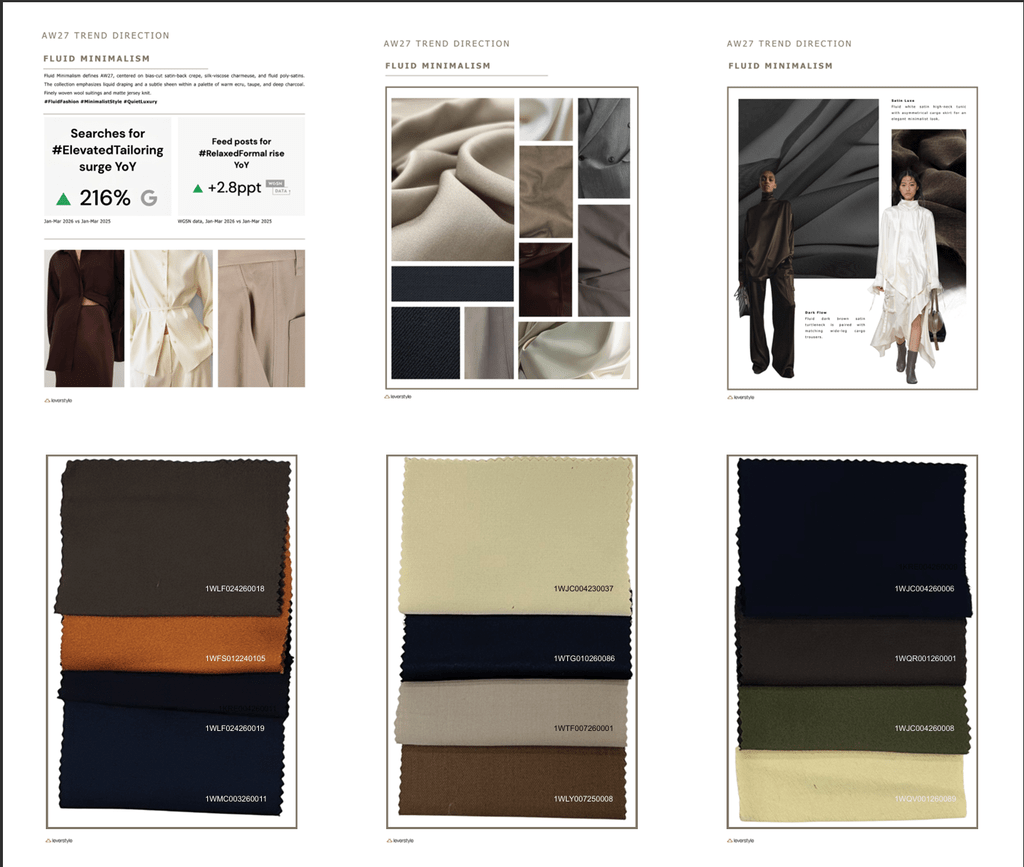
Fluid Minimalism is the anchor. Bio-based satin-back crepe, silk-viscose charmeuse and fluid poly-satins, with finely woven wool suitings and matte jersey underneath, in warm ecru, taupe and deep charcoal. Searches for elevated tailoring rose 216 percent year on year, and relaxed formal posts rose 2.8 points on the Fashion Feed.
Aspen Luxury takes the same restraint into cold weather through shearling, long-hair faux fur and fine ribbed knits, with wool and jersey blends layering underneath. The luxury ski wear market is forecast to grow 10.4 percent by 2027, and 58 percent of luxury consumers report prioritising high-performance ski apparel. For brands with an apres-ski capsule, this is the direction with the clearest commercial case attached.
Dark and decorative
Dark Romance evolves out of Opulent Romance toward moody escapist maximalism. Rich jacquard and velvet against delicate lace, chiffon and devore, styled with black distressed and embellished denim and rebellious metal hardware. Posts rose 1.9 percentage points, and TikTok carried 2.6 million views on the aesthetic in 2025.
Oriental Opulence sits alongside it and goes further into construction. Crushed and pleated silk-satin devore grounds, cut-velvet pile structures, jacquard weaves in poly-silk blends, and dense sequin-on-mesh embellishment. Ornate maximalism rose 1.2 points on the Fashion Feed year on year.
In print, Dark Romance layers moody florals against near-black grounds, Everyday Opulence offers arabesques, swirls and paisleys as a regal alternative to florals, and Dimensional Threads uses water-soluble layers to let embroidery stand off the fabric as surface texture.
This is the most intricate group in either book. Devore burns the pattern into the ground itself, cut velvet builds it in pile, and dimensional embroidery lifts it clear of the cloth altogether. Sampling here takes longer than anything else in the season.
Utility and craft
Safari Utility centres on waxed cotton-poly canvas and laminated brushed cotton twill, with tartan wool weaves paired with bonded wool suiting for structural definition. Searches for soft utility expanded 152 percent and for elevated utility 226 percent year on year.
Outback Craft is the handwork counterpart, applied across leather and suede through studding, perforation, laser cutting and fringe detailing, with grommet embellishment and handwork extending into cotton twills and canvases. Crafted details posts doubled during the AW25/26 to AW26/27 catwalk cycle. Prairie Frontier and Feathered Couture carry the same territory in print.
Americana and nostalgia
Farm Prairie blends workwear-inspired weaves and sturdy denim with broderie anglaise, paisley jacquard and lace, in a cool-toned palette that reads both rugged and feminine. Cottagecore searches rose 30 percent and broderie anglaise posts rose 1.6 points.
New Mod is the seasons colour outlet. Retro-inspired stripes and bold blocking, soft velour and bright indigo denims, reworking 60s and 70s mod references through modern texture. Searches for rugby top rose 39 percent year on year. Pattern Clash extends this in print by pairing checks with florals and chintz motifs at deliberately mismatched scale, while Dappled Forest handles the animal-print reset.
Rugged Vintage appears in the womenswear book on the same terms as menswear, making distressing and wash one of the few genuinely shared languages across the season.
What FW27 Adds Up To
Supply chain diversification fails when brands treat it as something to activate during a crisis. Qualifying a second country takes the same time whether the situation is urgent or not: fit approval, wash and finish standards, trim and hardware sourcing, testing protocols, and at least one production trial at real volume.
None of that requires capital commitment. It requires development calendar time, which makes pre-qualification the cheapest insurance available in apparel sourcing. A brand with a second country approved across its top ten styles can move inside a season. A brand starting from zero needs two. A second country on a vendor list means nothing; approved product in a second country means the option is real.
Talk to Our Team
Lever Style produces across eight countries in Asia and works with almost 200 brands, spanning soft tailoring, outerwear, denim, knitwear, activewear and lifestyle apparel. Because we build to each design rather than force a whole range down one route, a collection that spans washed denim, brushed wool tailoring and a devore evening piece can sit together in one collection.
The full FW27 books take every direction above further — full material and colour stories, with the print files ready to see in cloth. Download the FW27 Trend Direction books here.
If you are building your FW27 range now and want a closer look at the directions behind it, get in touch with our team.